Rate Equation
Objective
Define equation
Solve equation
Compute model and signal
In this example, we only deal with gaussian irf
# import needed module
import numpy as np
import matplotlib.pyplot as plt
import TRXASprefitpack
from TRXASprefitpack import solve_model, solve_seq_model, solve_l_model, compute_model, rate_eq_conv
plt.rcParams["figure.figsize"] = (12,9)
Version information
print(TRXASprefitpack.__version__)
0.6.0
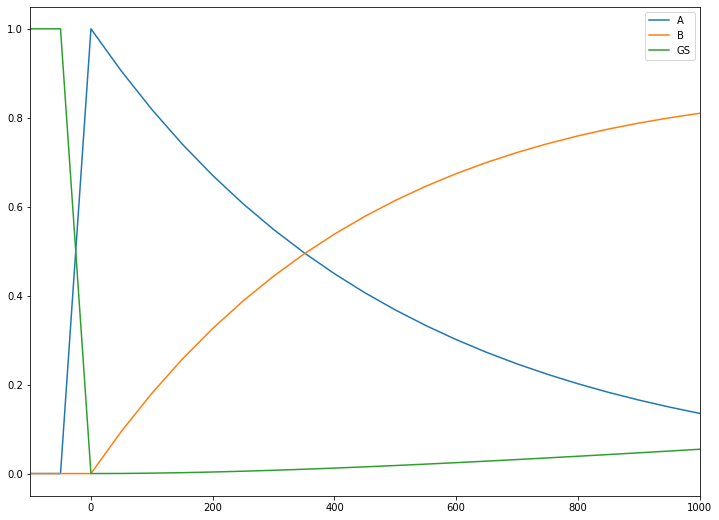
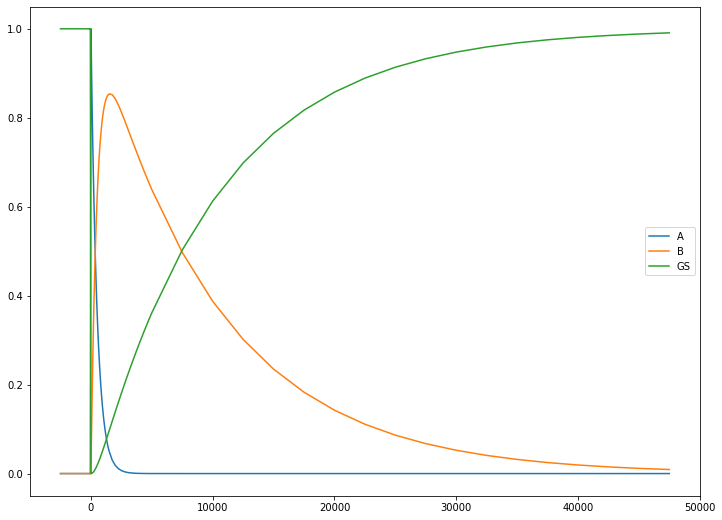
Define equation -sequential decay-
In pump-probe time resolved spectroscopy, the concentration of ground state is not much important. Only, the concentration of excited species are matter.
Consider following sequential decay model
'''
    k1     k2
A  ---> B ---> GS
y1: A
y2: B
y3: GS
'''
with initial condition
Then what we need to solve is
with \(y(0)=y_0\).
Where \(A\) is
This type of 1st order rate equation can be solved via solve_seq_model. Indeed solve_seq_model can solve following type of sequential decay.
1 --> 2 --> 3 --> ... --> n
# set lifetime tau1 = 500 ps, tau2 = 10 ns
# set fwhm of IRF = 100 ps

tau_1 = 500
tau_2 = 10000
fwhm = 100

# initial condition
y0 = np.array([1, 0, 0])

# set time range (mixed step)
t_seq1 = np.arange(-2500, -500, 100)
t_seq2 = np.arange(-500, 1500, 50)
t_seq3 = np.arange(1500, 5000, 250)
t_seq4 = np.arange(5000, 50000, 2500)

t_seq = np.hstack((t_seq1, t_seq2, t_seq3, t_seq4))

eigval_seq, V_seq, c_seq = solve_seq_model(np.array([tau_1, tau_2]), y0)
# Now compute model
y_seq = compute_model(t_seq, eigval_seq, V_seq, c_seq)


# since, y_1 + y_2 + y_3 = 1 for all t,
# y3 = 1 - (y_1+y_2)

y_seq[-1, :] = 1 - (y_seq[0, :] + y_seq[1, :])
plot model (sequential decay model)
plt.plot(t_seq, y_seq[0, :], label='A')
plt.plot(t_seq, y_seq[1, :], label='B')
plt.plot(t_seq, y_seq[2, :], label='GS')
plt.xlim(-100, 1000)
plt.legend()
plt.show()
Convolution with gaussian instrumental response function
plt.plot(t_seq, y_seq[0, :], label='A')
plt.plot(t_seq, y_seq[1, :], label='B')
plt.plot(t_seq, y_seq[2, :], label='GS')
plt.legend()
plt.show()
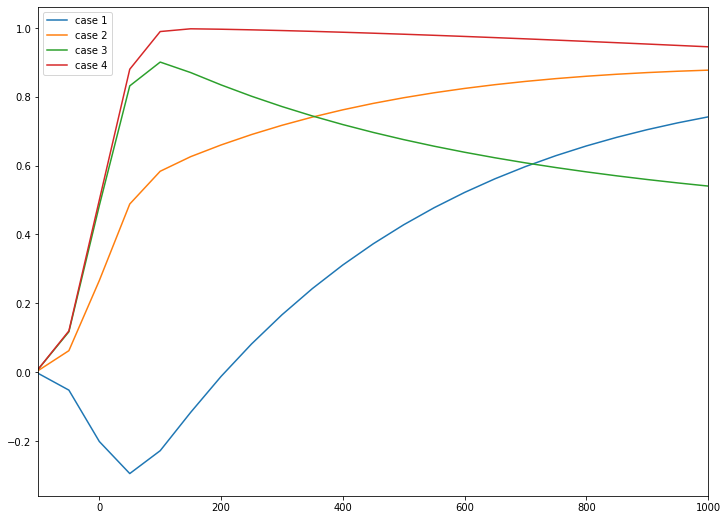
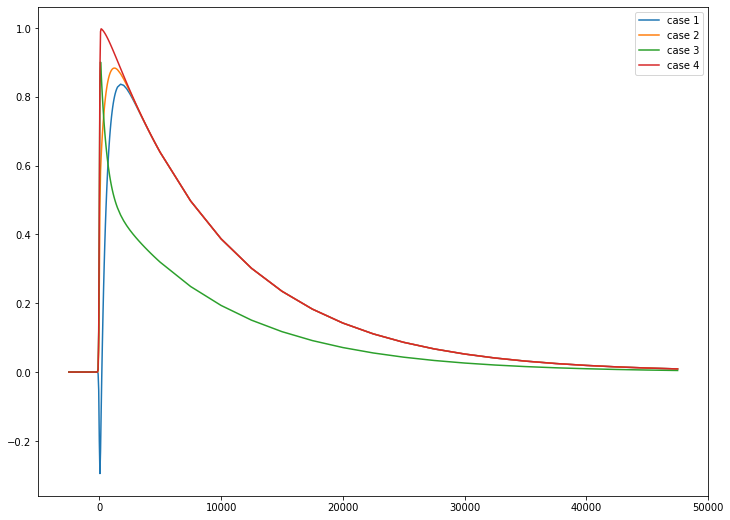
Compute Signal for sequential decay
Difference absorption coefficient of ground state is 0
case 1. Differential absorption coefficient of A : -0.5 and B : 1
case 2. A: 0.5 B: 1
case 3. A: 1 B: 0.5
case 4. A: 1 B: 1
diff_abs_1 = [-0.5, # A state
            1, # B state
            0, # ground state
           ]
diff_abs_2 = [0.5, 1, 0]
diff_abs_3 = [1, 0.5, 0]
diff_abs_4 = [1, 1, 0]
y_seq_1 = rate_eq_conv(t_seq, fwhm, diff_abs_1, eigval_seq, V_seq, c_seq)
y_seq_2 = rate_eq_conv(t_seq, fwhm, diff_abs_2, eigval_seq, V_seq, c_seq)
y_seq_3 = rate_eq_conv(t_seq, fwhm, diff_abs_3, eigval_seq, V_seq, c_seq)
y_seq_4 = rate_eq_conv(t_seq, fwhm, diff_abs_4, eigval_seq, V_seq, c_seq)
Plot signal (sequential decay)
plt.plot(t_seq, y_seq_1, label='case 1')
plt.plot(t_seq, y_seq_2, label='case 2')
plt.plot(t_seq, y_seq_3, label='case 3')
plt.plot(t_seq, y_seq_4, label='case 4')
plt.xlim(-100, 1000)
plt.legend()
plt.show()
plt.plot(t_seq, y_seq_1, label='case 1')
plt.plot(t_seq, y_seq_2, label='case 2')
plt.plot(t_seq, y_seq_3, label='case 3')
plt.plot(t_seq, y_seq_4, label='case 4')
plt.legend()
plt.show()
Define equation -branched decay-
Consider following branched decay model
'''
    k1     k3
A  ---> B ---> GS
 \
  \
k2 \
    \
     > C ---> GS
          k4
y1: A
y2: B
y3: C
y4: GS
'''
with initial condition
Then what we need to solve is
with \(y(0)=y_0\).
Where \(A\) is
As one can see the rate equation matrix A is lower triangle.
This lower triangle type 1st order rate equation can be solved via solve_l_model
# set lifetime tau1: 300 fs, tau2: 500 fs, tau3: 1 ns, tau 4: 500 ps
# set fwhm of IRF = 150 fs

tau_1 = 0.3
tau_2 = 0.5
tau_3 = 1000
tau_4 = 500
fwhm = 0.15

# initial condition
y0 = np.array([1, 0, 0, 0])

# rate equation matrix
A = np.array([[-(1/tau_1+1/tau_2), 0, 0, 0],
[1/tau_1, -1/tau_3, 0, 0],
[1/tau_2, 0, -1/tau_4, 0],
[0,1/tau_3, 1/tau_4, 0]
])


# set time range (mixed step)
t_1 = np.arange(-2, -1, 0.1)
t_2 = np.arange(-1, 1, 0.05)
t_3 = np.arange(1, 10, 1)
t_4 = np.arange(10, 100, 10)
t_5 = np.arange(100, 1500, 100)

t_branch = np.hstack((t_1, t_2, t_3, t_4, t_5))

eigval_branch, V_branch, c_branch = solve_l_model(A, y0)
# Now compute model
y_branch = compute_model(t_branch, eigval_branch, V_branch, c_branch)


# since, y_1 + y_2 + y_3 + y_4 = 1 for all t,
# y4 = 1 - (y_1+y_2+y_3)

y_branch[-1, :] = 1 - (y_branch[0, :] + y_branch[1, :] + y_branch[2, :])
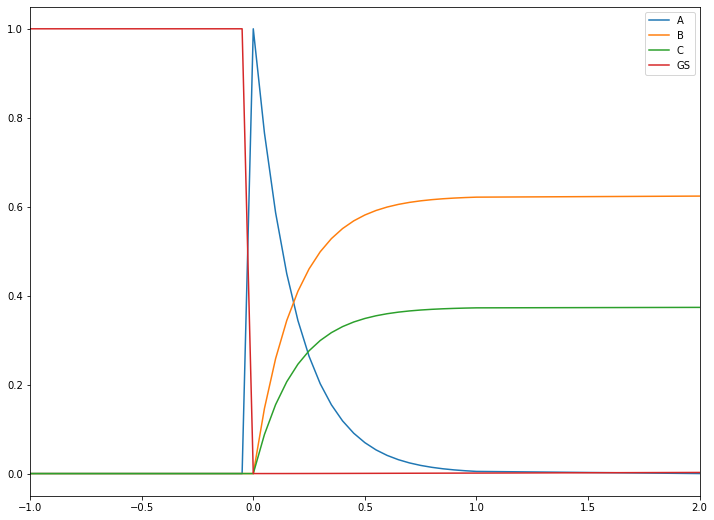
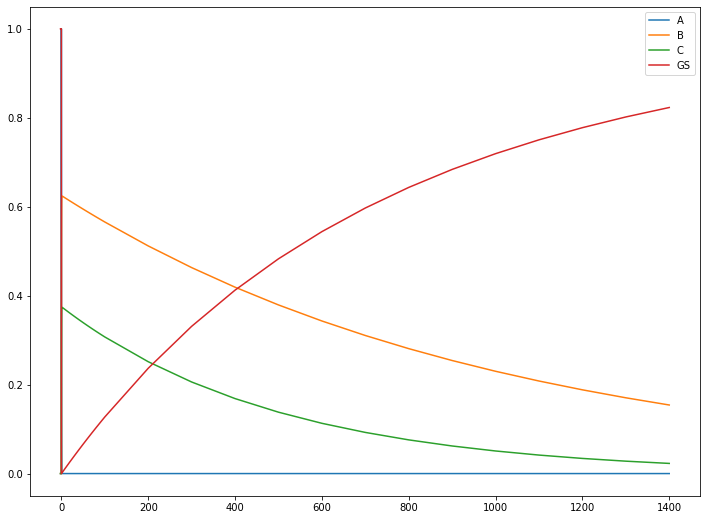
plot model (branched decay model)
plt.plot(t_branch, y_branch[0, :], label='A')
plt.plot(t_branch, y_branch[1, :], label='B')
plt.plot(t_branch, y_branch[2, :], label='C')
plt.plot(t_branch, y_branch[3, :], label='GS')
plt.legend()
plt.xlim(-1, 2)
plt.show()
plt.plot(t_branch, y_branch[0, :], label='A')
plt.plot(t_branch, y_branch[1, :], label='B')
plt.plot(t_branch, y_branch[2, :], label='C')
plt.plot(t_branch, y_branch[3, :], label='GS')
plt.legend()
plt.show()
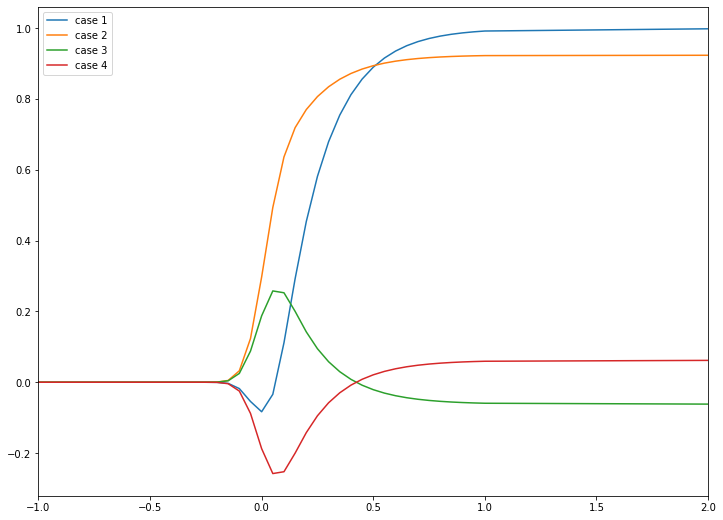
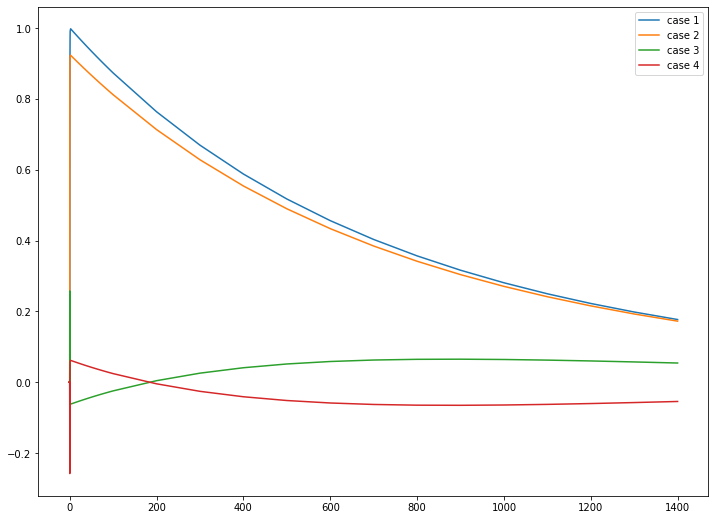
Compute Signal for branched decay
Difference absorption coefficient of ground state is 0
case 1. Differential absorption coefficient of A : -0.5 and B : 1 C: 1
case 2. A: 0.5 B: 1 C: 0.8
case 3. A: 0.5 B: 0.5 C: 1
case 4. A: -0.5 B: -0.5 C: 1
diff_abs_1 = [-0.5, # A state
            1, # B state
            1, # C
            0, # Ground State
           ]
diff_abs_2 = [0.5, 1, 0.8, 0]
diff_abs_3 = [0.5, 0.5, -1, 0]
diff_abs_4 = [-0.5, -0.5, 1, 0]
y_branch_1 = rate_eq_conv(t_branch, fwhm, diff_abs_1, eigval_branch, V_branch, c_branch)
y_branch_2 = rate_eq_conv(t_branch, fwhm, diff_abs_2, eigval_branch, V_branch, c_branch)
y_branch_3 = rate_eq_conv(t_branch, fwhm, diff_abs_3, eigval_branch, V_branch, c_branch)
y_branch_4 = rate_eq_conv(t_branch, fwhm, diff_abs_4, eigval_branch, V_branch, c_branch)
Plot Signal for branched decay
plt.plot(t_branch, y_branch_1, label='case 1')
plt.plot(t_branch, y_branch_2, label='case 2')
plt.plot(t_branch, y_branch_3, label='case 3')
plt.plot(t_branch, y_branch_4, label='case 4')
plt.legend()
plt.xlim(-1, 2)
plt.show()
plt.plot(t_branch, y_branch_1, label='case 1')
plt.plot(t_branch, y_branch_2, label='case 2')
plt.plot(t_branch, y_branch_3, label='case 3')
plt.plot(t_branch, y_branch_4, label='case 4')
plt.legend()
plt.show()
Conclusion
This example introduce solve_seq_model and solve_l_model to solve special kind of rate equation and demonstrates how signal changes when varying differential absolution coefficients of each excited state species.