Fitting with time delay scan (model: sum of exponential decay and damped oscillation)
Objective
Fitting with sum of exponential decay model and damped oscillation model
Save and Load fitting result
Calculates species associated coefficent from fitting result
Evaluates F-test based confidence interval
In this example, we only deal with gaussian irf
# import needed module
import numpy as np
import matplotlib.pyplot as plt
import TRXASprefitpack
from TRXASprefitpack import solve_seq_model, rate_eq_conv, dmp_osc_conv_gau
plt.rcParams["figure.figsize"] = (12,9)
Version information
print(TRXASprefitpack.__version__)
0.7.0
Detecting oscillation feature
# Generates fake experiment data
# Model: 1 -> 2 -> 3 -> GS
# lifetime tau1: 500 fs, tau2: 10 ps, tau3: 1000 ps
# oscillation: tau_osc: 1 ps, period_osc: 300 fs, phase: pi/4
# fwhm paramter of gaussian IRF: 100 fs

tau_1 = 0.5
tau_2 = 10
tau_3 = 1000
fwhm = 0.100
tau_osc = 1
period_osc = 0.3
phase = np.pi/4

# initial condition
y0 = np.array([1, 0, 0, 0])

# set time range (mixed step)
t_seq1 = np.arange(-2, -1, 0.2)
t_seq2 = np.arange(-1, 2, 0.02)
t_seq3 = np.arange(2, 5, 0.2)
t_seq4 = np.arange(5, 10, 1)
t_seq5 = np.arange(10, 100, 10)
t_seq6 = np.arange(100, 1000, 100)
t_seq7 = np.linspace(1000, 2000, 2)

t_seq = np.hstack((t_seq1, t_seq2, t_seq3, t_seq4, t_seq5, t_seq6, t_seq7))

eigval_seq, V_seq, c_seq = solve_seq_model(np.array([tau_1, tau_2, tau_3]), y0)

# Now generates measured transient signal
# Last element is ground state

abs_1 = [1, 1, 1, 0]; abs_1_osc = 0.05
abs_2 = [0.5, 0.8, 0.2, 0]; abs_2_osc = 0.001
abs_3 = [-0.5, 0.7, 0.9, 0]; abs_3_osc = -0.002
abs_4 = [0.6, 0.3, -1, 0]; abs_4_osc = 0.0018

t0 = np.random.normal(0, fwhm, 4) # perturb time zero of each scan

# generate measured data

y_obs_1 = rate_eq_conv(t_seq-t0[0], fwhm, abs_1, eigval_seq, V_seq, c_seq, irf='g')+\
    abs_1_osc*dmp_osc_conv_gau(t_seq-t0[0], fwhm, 1/tau_osc, period_osc, phase)
y_obs_2 = rate_eq_conv(t_seq-t0[1], fwhm, abs_2, eigval_seq, V_seq, c_seq, irf='g')+\
    abs_2_osc*dmp_osc_conv_gau(t_seq-t0[1], fwhm, 1/tau_osc, period_osc, phase)
y_obs_3 = rate_eq_conv(t_seq-t0[2], fwhm, abs_3, eigval_seq, V_seq, c_seq, irf='g')+\
    abs_3_osc*dmp_osc_conv_gau(t_seq-t0[2], fwhm, 1/tau_osc, period_osc, phase)
y_obs_4 = rate_eq_conv(t_seq-t0[3], fwhm, abs_4, eigval_seq, V_seq, c_seq, irf='g')+\
    abs_4_osc*dmp_osc_conv_gau(t_seq-t0[3], fwhm, 1/tau_osc, period_osc, phase)

# generate random noise with (S/N = 200)

# Define noise level (S/N=200) w.r.t peak
eps_obs_1 = np.max(np.abs(y_obs_1))/200*np.ones_like(y_obs_1)
eps_obs_2 = np.max(np.abs(y_obs_2))/200*np.ones_like(y_obs_2)
eps_obs_3 = np.max(np.abs(y_obs_3))/200*np.ones_like(y_obs_3)
eps_obs_4 = np.max(np.abs(y_obs_4))/200*np.ones_like(y_obs_4)

# generate random noise
noise_1 = np.random.normal(0, eps_obs_1, t_seq.size)
noise_2 = np.random.normal(0, eps_obs_2, t_seq.size)
noise_3 = np.random.normal(0, eps_obs_3, t_seq.size)
noise_4 = np.random.normal(0, eps_obs_4, t_seq.size)


# generate measured intensity
i_obs_1 = y_obs_1 + noise_1
i_obs_2 = y_obs_2 + noise_2
i_obs_3 = y_obs_3 + noise_3
i_obs_4 = y_obs_4 + noise_4

# print real values

print('-'*24)
print(f'fwhm: {fwhm}')
print(f'tau_1: {tau_1}')
print(f'tau_2: {tau_2}')
print(f'tau_3: {tau_3}')
print(f'tau_osc: {tau_osc}')
print(f'period_osc: {period_osc}')
print(f'phase_osc: {phase}')
for i in range(4):
    print(f't_0_{i+1}: {t0[i]}')
print('-'*24)
print('Excited Species contribution')
print(f'scan 1: {abs_1[0]} \t {abs_1[1]} \t {abs_1[2]}')
print(f'scan 2: {abs_2[0]} \t {abs_2[1]} \t {abs_2[2]}')
print(f'scan 3: {abs_3[0]} \t {abs_3[1]} \t {abs_3[2]}')
print(f'scan 4: {abs_4[0]} \t {abs_4[1]} \t {abs_4[2]}')

param_exact = [fwhm, t0[0], t0[1], t0[2], t0[3], tau_1, tau_2, tau_3, tau_osc, period_osc, phase]

data1 = np.vstack((t_seq, i_obs_1, eps_obs_1)).T
data2 = np.vstack((t_seq, i_obs_2, eps_obs_2)).T
data3 = np.vstack((t_seq, i_obs_3, eps_obs_3)).T
data4 = np.vstack((t_seq, i_obs_4, eps_obs_4)).T
------------------------
fwhm: 0.1
tau_1: 0.5
tau_2: 10
tau_3: 1000
tau_osc: 1
period_osc: 0.3
phase_osc: 0.7853981633974483
t_0_1: -0.004960794315238031
t_0_2: 0.15689212316332068
t_0_3: -0.05307330175122729
t_0_4: -0.045460069698502054
------------------------
Excited Species contribution
scan 1: 1 	 1 	 1
scan 2: 0.5 	 0.8 	 0.2
scan 3: -0.5 	 0.7 	 0.9
scan 4: 0.6 	 0.3 	 -1
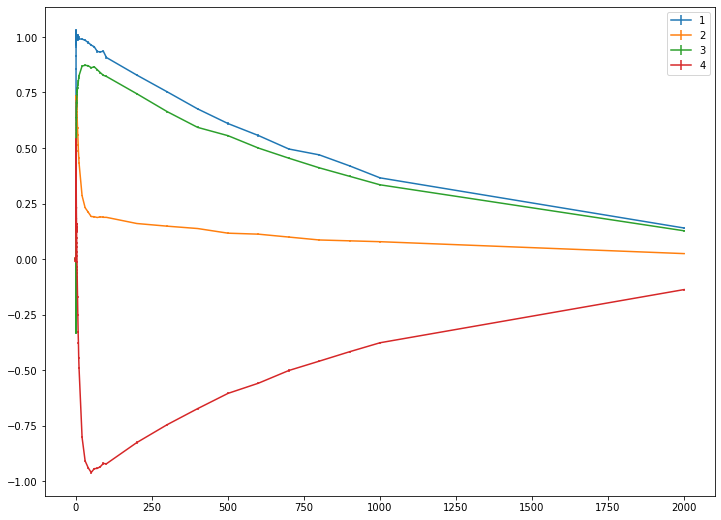
# plot model experimental data

plt.errorbar(t_seq, i_obs_1, eps_obs_1, label='1')
plt.errorbar(t_seq, i_obs_2, eps_obs_2, label='2')
plt.errorbar(t_seq, i_obs_3, eps_obs_3, label='3')
plt.errorbar(t_seq, i_obs_4, eps_obs_4, label='4')
plt.legend()
plt.show()
plt.errorbar(t_seq, i_obs_1, eps_obs_1, label='1')
plt.errorbar(t_seq, i_obs_2, eps_obs_2, label='2')
plt.errorbar(t_seq, i_obs_3, eps_obs_3, label='3')
plt.errorbar(t_seq, i_obs_4, eps_obs_4, label='4')
plt.legend()
plt.xlim(-10*fwhm, 20*fwhm)
plt.show()
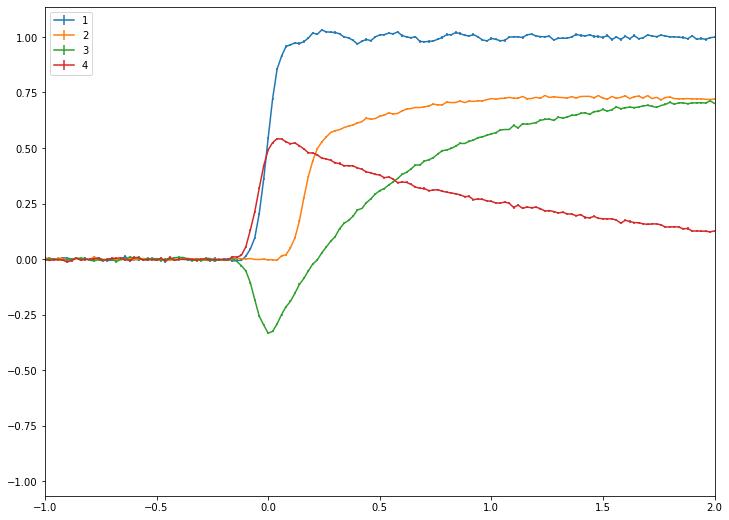
We can show oscillation feature at scan 1. First try fitting without oscillation.
# import needed module for fitting
from TRXASprefitpack import fit_transient_exp

# time, intensity, eps should be sequence of numpy.ndarray
t = [t_seq]
intensity = [np.vstack((i_obs_1, i_obs_2, i_obs_3, i_obs_4)).T]
eps = [np.vstack((eps_obs_1, eps_obs_2, eps_obs_3, eps_obs_4)).T]

# set initial guess
irf = 'g' # shape of irf function
fwhm_init = 0.15
t0_init = np.array([0, 0, 0, 0])
# test with one decay module
tau_init = np.array([0.2, 20, 1500])

fit_result_decay = fit_transient_exp(irf, fwhm_init, t0_init, tau_init, False,
method_glb='ampgo', t=t, intensity=intensity, eps=eps)
# print fitting result
print(fit_result_decay)
[Model information]
    model : decay
    irf: g
    fwhm:  0.1008
    eta:  0.0000
    base: False

[Optimization Method]
    global: ampgo
    leastsq: trf

[Optimization Status]
    nfev: 2041
    status: 0
    global_opt msg: Requested Number of global iteration is finished.
    leastsq_opt msg: Both `ftol` and `xtol` termination conditions are satisfied.

[Optimization Results]
    Total Data points: 780
    Number of effective parameters: 20
    Degree of Freedom: 760
    Chi squared:  1275.7074
    Reduced chi squared:  1.6786
    AIC (Akaike Information Criterion statistic):  423.7305
    BIC (Bayesian Information Criterion statistic):  516.9164

[Parameters]
    fwhm_G:  0.10078759 +/-  0.00086777 ( 0.86%)
    t_0_1_1: -0.00492989 +/-  0.00040536 ( 8.22%)
    t_0_1_2:  0.15762339 +/-  0.00057744 ( 0.37%)
    t_0_1_3: -0.05206847 +/-  0.00073086 ( 1.40%)
    t_0_1_4: -0.04566810 +/-  0.00062384 ( 1.37%)
    tau_1:  0.50065445 +/-  0.00238790 ( 0.48%)
    tau_2:  10.06788181 +/-  0.05087053 ( 0.51%)
    tau_3:  1002.04361193 +/-  4.54481798 ( 0.45%)

[Parameter Bound]
    fwhm_G:  0.075 <=  0.10078759 <=  0.3
    t_0_1_1: -0.3 <= -0.00492989 <=  0.3
    t_0_1_2: -0.3 <=  0.15762339 <=  0.3
    t_0_1_3: -0.3 <= -0.05206847 <=  0.3
    t_0_1_4: -0.3 <= -0.04566810 <=  0.3
    tau_1:  0.075 <=  0.50065445 <=  1.2
    tau_2:  4.8 <=  10.06788181 <=  76.8
    tau_3:  307.2 <=  1002.04361193 <=  4915.2


[Component Contribution]
    DataSet dataset_1:
     #tscan	tscan_1	tscan_2	tscan_3	tscan_4
     decay 1	-0.67%	-28.38%	-51.32%	 8.96%
     decay 2	-1.09%	 54.26%	-9.44%	 52.51%
     decay 3	 98.24%	 17.36%	 39.23%	-38.53%

[Parameter Correlation]
    Parameter Correlations >  0.1 are reported.
    (tau_1, t_0_1_2) =  0.116
    (tau_1, t_0_1_3) = -0.356
    (tau_2, t_0_1_4) =  0.105
    (tau_3, tau_2) = -0.169
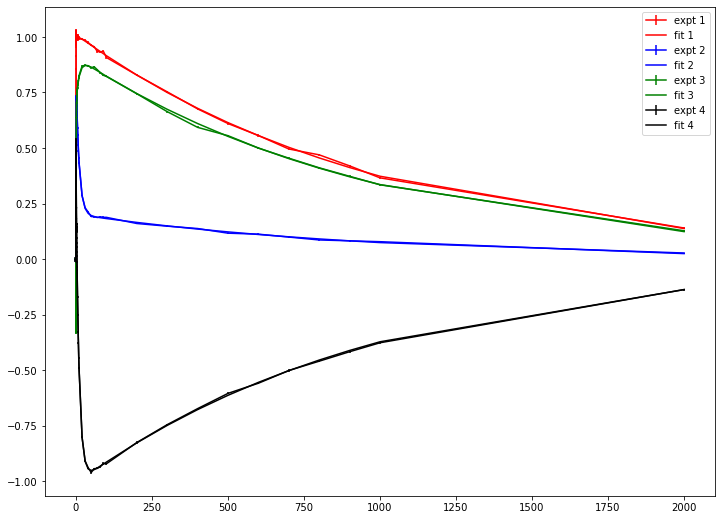
# plot fitting result and experimental data

color_lst = ['red', 'blue', 'green', 'black']

for i in range(4):
    plt.errorbar(t[0], intensity[0][:, i], eps[0][:, i], label=f'expt {i+1}', color=color_lst[i])
    plt.errorbar(t[0], fit_result_decay['fit'][0][:, i], label=f'fit {i+1}', color=color_lst[i])

plt.legend()
plt.show()
# plot with shorter time range

for i in range(4):
    plt.errorbar(t[0], intensity[0][:, i], eps[0][:, i], label=f'expt {i+1}', color=color_lst[i])
    plt.errorbar(t[0], fit_result_decay['fit'][0][:, i], label=f'fit {i+1}', color=color_lst[i])

plt.legend()
plt.xlim(-10*fwhm_init, 20*fwhm_init)
plt.show()
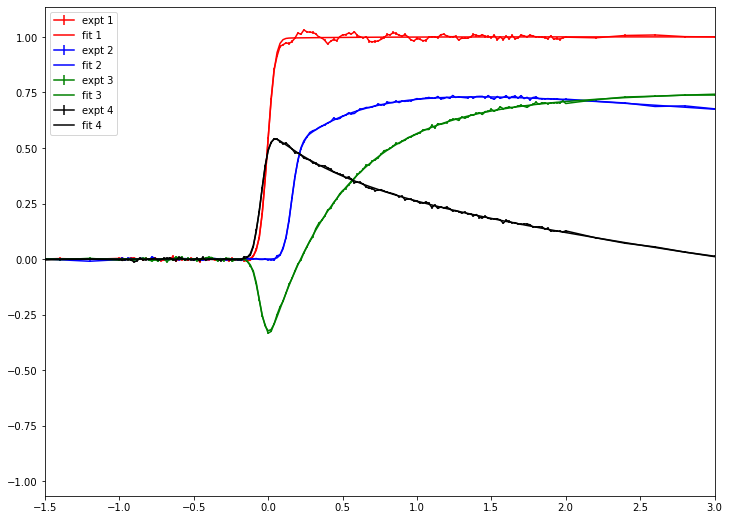
There may exists oscillation in experimental scan 1. To show oscillation feature plot residual (expt-fit)
# To show oscillation feature plot residual
for i in range(4):
    plt.errorbar(t[0], fit_result_decay['res'][0][:, i], eps[0][:, i], label=f'res {i+1}', color=color_lst[i])

plt.legend()
plt.xlim(-10*fwhm_init, 20*fwhm_init)
plt.show()
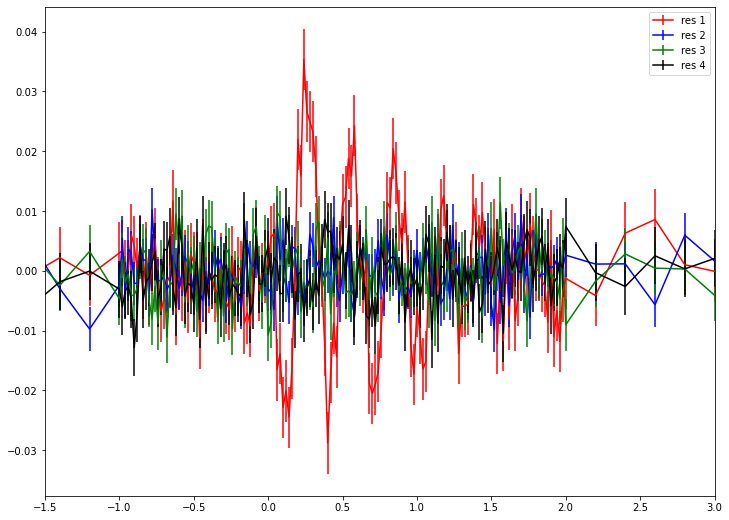
Only residual for experimental scan 1 shows clear oscillation feature, Now add oscillation feature.
from TRXASprefitpack import fit_transient_both
tau_osc_init = np.array([1.5])
period_osc_init = np.array([0.5])

fit_result_decay_osc = fit_transient_both(irf, fwhm_init, t0_init, tau_init,
tau_osc_init, period_osc_init,
False, method_glb='ampgo', kwargs_lsq={'verbose' : 2}, t=t, intensity=intensity, eps=eps)
   Iteration     Total nfev        Cost      Cost reduction    Step norm     Optimality
       0              1         3.9673e+02                                    4.01e-01
       1              2         3.9673e+02      1.01e-06       2.04e-04       5.02e-02
`ftol` termination condition is satisfied.
Function evaluations 2, initial cost 3.9673e+02, final cost 3.9673e+02, first-order optimality 5.02e-02.
# print fitting result
print(fit_result_decay_osc)
[Model information]
    model : both
    irf: g
    fwhm:  0.0994
    eta:  0.0000
    base: False

[Optimization Method]
    global: ampgo
    leastsq: trf

[Optimization Status]
    nfev: 4098
    status: 0
    global_opt msg: Requested Number of global iteration is finished.
    leastsq_opt msg: `ftol` termination condition is satisfied.

[Optimization Results]
    Total Data points: 780
    Number of effective parameters: 30
    Degree of Freedom: 750
    Chi squared:  793.4582
    Reduced chi squared:  1.0579
    AIC (Akaike Information Criterion statistic):  73.3434
    BIC (Bayesian Information Criterion statistic):  213.1222

[Parameters]
    fwhm_G:  0.09942893 +/-  0.00073364 ( 0.74%)
    t_0_1_1: -0.00436417 +/-  0.00038112 ( 8.73%)
    t_0_1_2:  0.15745573 +/-  0.00050598 ( 0.32%)
    t_0_1_3: -0.05166261 +/-  0.00063012 ( 1.22%)
    t_0_1_4: -0.04598766 +/-  0.00054710 ( 1.19%)
    tau_1:  0.50061835 +/-  0.00194008 ( 0.39%)
    tau_2:  10.06476610 +/-  0.04045717 ( 0.40%)
    tau_3:  1001.48020933 +/-  3.60493654 ( 0.36%)
    tau_osc_1:  0.87702449 +/-  0.09291512 ( 10.59%)
    period_osc_1:  0.29790060 +/-  0.00173860 ( 0.58%)

[Parameter Bound]
    fwhm_G:  0.075 <=  0.09942893 <=  0.3
    t_0_1_1: -0.3 <= -0.00436417 <=  0.3
    t_0_1_2: -0.3 <=  0.15745573 <=  0.3
    t_0_1_3: -0.3 <= -0.05166261 <=  0.3
    t_0_1_4: -0.3 <= -0.04598766 <=  0.3
    tau_1:  0.075 <=  0.50061835 <=  1.2
    tau_2:  4.8 <=  10.06476610 <=  76.8
    tau_3:  307.2 <=  1001.48020933 <=  4915.2
    tau_osc_1:  0.3 <=  0.87702449 <=  4.8
    period_osc_1:  0.075 <=  0.29790060 <=  1.2

[Phase Factor]
    DataSet dataset_1:
     #tscan	tscan_1	tscan_2	tscan_3	tscan_4
     dmp_osc 1	 0.2121 π	 0.3720 π	 0.9861 π	 0.7577 π

[Component Contribution]
    DataSet dataset_1:
     #tscan	tscan_1	tscan_2	tscan_3	tscan_4
     decay 1	 0.29%	-28.35%	-51.22%	 8.92%
     decay 2	-1.25%	 54.14%	-9.44%	 52.47%
     decay 3	 93.46%	 17.32%	 39.18%	-38.49%
    dmp_osc 1	 5.00%	 0.19%	 0.17%	 0.11%

[Parameter Correlation]
    Parameter Correlations >  0.1 are reported.
    (t_0_1_1, fwhm_G) =  0.232
    (t_0_1_2, fwhm_G) =  0.154
    (t_0_1_4, fwhm_G) =  0.103
    (tau_1, t_0_1_2) =  0.105
    (tau_1, t_0_1_3) = -0.351
    (tau_2, t_0_1_4) =  0.105
    (tau_3, tau_2) = -0.169
    (tau_osc_1, t_0_1_1) = -0.112
    (period_osc_1, fwhm_G) = -0.241
    (period_osc_1, t_0_1_1) = -0.455
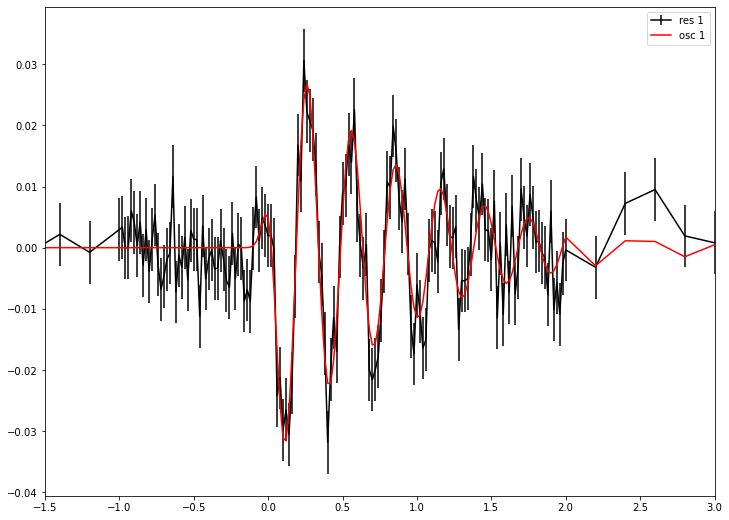
# plot residual and oscilation fit

for i in range(1):
    plt.errorbar(t[0], intensity[0][:, i]-fit_result_decay_osc['fit_decay'][0][:, i], eps[0][:, i], label=f'res {i+1}', color='black')
    plt.errorbar(t[0], fit_result_decay_osc['fit_osc'][0][:, i], label=f'osc {i+1}', color='red')

plt.legend()
plt.xlim(-10*fwhm_init, 20*fwhm_init)
plt.show()

print()
# Compare fitting value and exact value
for i in range(len(fit_result_decay_osc['x'])):
    print(f"{fit_result_decay_osc['param_name'][i]}: {fit_result_decay_osc['x'][i]} (fit) \t {param_exact[i]} (exact)")
fwhm_G: 0.09942893461280397 (fit) 	 0.1 (exact)
t_0_1_1: -0.004364170362199773 (fit) 	 -0.004960794315238031 (exact)
t_0_1_2: 0.157455725987222 (fit) 	 0.15689212316332068 (exact)
t_0_1_3: -0.051662610558068776 (fit) 	 -0.05307330175122729 (exact)
t_0_1_4: -0.04598765885010275 (fit) 	 -0.045460069698502054 (exact)
tau_1: 0.5006183545563633 (fit) 	 0.5 (exact)
tau_2: 10.064766102710598 (fit) 	 10 (exact)
tau_3: 1001.4802093272855 (fit) 	 1000 (exact)
tau_osc_1: 0.8770244895485201 (fit) 	 1 (exact)
period_osc_1: 0.29790060227720216 (fit) 	 0.3 (exact)
# save fitting result to file
from TRXASprefitpack import save_TransientResult, load_TransientResult

save_TransientResult(fit_result_decay_osc, 'example_decay_osc') # save fitting result to example_decay_2.h5
loaded_result = load_TransientResult('example_decay_osc') # load fitting result from example_decay_2.h5
Now deduce species associated difference coefficient from sequential decay model
y0 = np.array([1, 0, 0, 0]) # initial cond
eigval, V, c = solve_seq_model(loaded_result['x'][5:-2], y0)

# compute scaled V matrix
V_scale = np.einsum('j,ij->ij', c, V)
diff_abs_fit = np.linalg.solve(V_scale[:-1, :-1].T, loaded_result['c'][0][:-1,:])
# slice last column and row corresponding to ground state
# exclude oscillation factor

# compare with exact result
print('-'*24)
print('[Species Associated Difference Coefficent]')
print('scan # \t ex 1 (fit) \t ex 1 (exact) \t ex 2 (fit) \t ex 2 (exact) \t ex 3 (exact)')
print(f'1 \t {diff_abs_fit[0,0]} \t {abs_1[0]}  \t {diff_abs_fit[1,0]} \t {abs_1[1]} \t {diff_abs_fit[2,0]} \t {abs_1[2]}')
print(f'2 \t {diff_abs_fit[0,1]} \t {abs_2[0]}  \t {diff_abs_fit[1,1]} \t {abs_2[1]} \t {diff_abs_fit[2,1]} \t {abs_2[2]}')
print(f'3 \t {diff_abs_fit[0,2]} \t {abs_3[0]}  \t {diff_abs_fit[1,2]} \t {abs_3[1]} \t {diff_abs_fit[2,2]} \t {abs_3[2]}')
print(f'4 \t {diff_abs_fit[0,3]} \t {abs_4[0]}  \t {diff_abs_fit[1,3]} \t {abs_4[1]} \t {diff_abs_fit[2,3]} \t {abs_4[2]}')
------------------------
[Species Associated Difference Coefficent]
scan # 	 ex 1 (fit) 	 ex 1 (exact) 	 ex 2 (fit) 	 ex 2 (exact) 	 ex 3 (exact)
1 	 1.0016166620198441 	 1  	 0.9986909891212575 	 1 	 1.001358106266621 	 1
2 	 0.5014287754315223 	 0.5  	 0.7996731266907202 	 0.8 	 0.19931745207235022 	 0.2
3 	 -0.49838742783791146 	 -0.5  	 0.7007968038257401 	 0.7 	 0.8997625681399827 	 0.9
4 	 0.6007589231190612 	 0.6  	 0.2987208907068396 	 0.3 	 -0.9990377055850692 	 -1
It also matches well, as expected.
Now calculates F-test based confidence interval.
from TRXASprefitpack import confidence_interval

ci_result = confidence_interval(loaded_result, 0.05) # set significant level: 0.05 -> 95% confidence level
print(ci_result) # report confidence interval
[Report for Confidence Interval]
    Method: f
    Significance level:  5.000000e-02

[Confidence interval]
    0.09934728 -  0.0013406 <= fwhm_G <=  0.09934728 +  0.00135011
    0.04287779 -  0.00070775 <= t_0_1_1 <=  0.04287779 +  0.00071158
    0.06571111 -  0.00091867 <= t_0_1_2 <=  0.06571111 +  0.0009173
    -0.03062846 -  0.00114751 <= t_0_1_3 <= -0.03062846 +  0.0011475
    -0.07308943 -  0.00101283 <= t_0_1_4 <= -0.07308943 +  0.00100992
    0.49989437 -  0.00357168 <= tau_1 <=  0.49989437 +  0.00359769
    9.94396867 -  0.07179097 <= tau_2 <=  9.94396867 +  0.07248221
    999.77303556 -  6.61535874 <= tau_3 <=  999.77303556 +  6.67752365
    0.97567546 -  0.17879022 <= tau_osc_1 <=  0.97567546 +  0.24094418
    0.29895246 -  0.00329794 <= period_osc_1 <=  0.29895246 +  0.00326387
# compare with ase
from scipy.stats import norm

factor = norm.ppf(1-0.05/2)

print('[Confidence interval (from ASE)]')
for i in range(loaded_result['param_name'].size):
    print(f"{loaded_result['x'][i]: .8f} - {factor*loaded_result['x_eps'][i] :.8f}",
          f"<= {loaded_result['param_name'][i]} <=", f"{loaded_result['x'][i] :.8f} + {factor*loaded_result['x_eps'][i]: .8f}")
[Confidence interval (from ASE)]
 0.09934728 - 0.00134839 <= fwhm_G <= 0.09934728 +  0.00134839
 0.04287779 - 0.00070060 <= t_0_1_1 <= 0.04287779 +  0.00070060
 0.06571111 - 0.00091885 <= t_0_1_2 <= 0.06571111 +  0.00091885
-0.03062846 - 0.00114879 <= t_0_1_3 <= -0.03062846 +  0.00114879
-0.07308943 - 0.00100681 <= t_0_1_4 <= -0.07308943 +  0.00100681
 0.49989437 - 0.00358743 <= tau_1 <= 0.49989437 +  0.00358743
 9.94396867 - 0.07309839 <= tau_2 <= 9.94396867 +  0.07309839
 999.77303556 - 6.63799029 <= tau_3 <= 999.77303556 +  6.63799029
 0.97567546 - 0.20313149 <= tau_osc_1 <= 0.97567546 +  0.20313149
 0.29895246 - 0.00317641 <= period_osc_1 <= 0.29895246 +  0.00317641
However, as you can see, in many case, ASE does not much different from more sophisticated f-test based error estimation.